
After a semi or 18-wheeler hits you in New Orleans, your claim depends on the truck’s own logs and electronic data, which can be lost or overwritten. It also depends on commercial insurance that can come in layers from more than one company. That makes it a different fight from an ordinary car wreck. As 18-wheeler accident lawyers, we act fast to secure the truck’s data and find every insurance policy that might help your claim.
What makes an 18-wheeler claim different from other truck claims
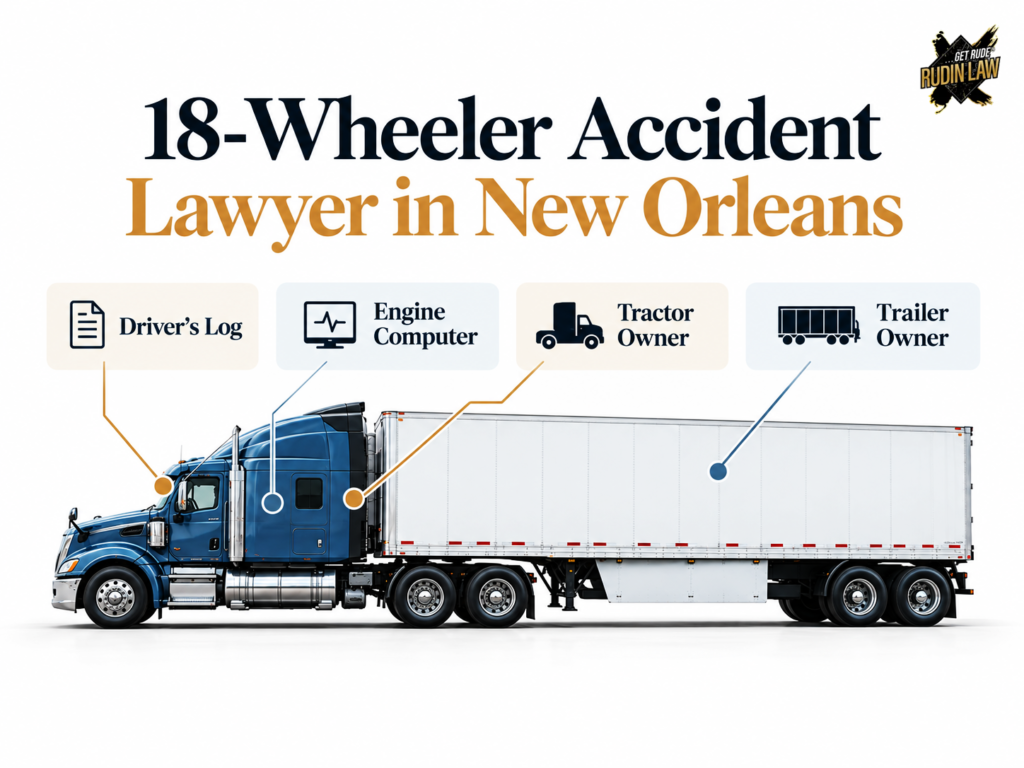
An 18-wheeler is a tractor and a trailer, and each one can have a different owner. So one crash can involve more than one company and more than one insurance layer. And a rig hauling in interstate commerce can leave behind federal records and data.
If you were hit by a different type of truck, we can explain how we handle each kind of truck accident case.
Federal law says a vehicle used in interstate commerce is a commercial motor vehicle if it meets any of four tests (49 C.F.R. § 390.5). The Federal Motor Carrier Safety Administration (FMCSA) sets the safety rules for motor carriers. Motor carrier is the legal term for a trucking company. The rules cover hours of service, electronic logging, drug and alcohol testing, and vehicle inspection and maintenance (49 C.F.R. Chapter III). Hours of service are the federal limits on how long a covered truck driver can drive.
If a carrier breaks the federal safety rules, that by itself doesn’t make it liable. But the violation can help show if the carrier owed and breached a duty of care under Louisiana’s duty-risk analysis. That’s the test Louisiana courts use to decide negligence.
A motor carrier is responsible for the harm its driver negligently causes while doing the carrier’s work, which Louisiana courts call acting within the course and scope of employment (La. C.C. art. 2320).
Any of these companies can be linked to a big rig. Each can have its own insurance.
- The tractor owner. That’s the company that owns the front part with the engine and cab.
- The trailer owner. The trailer might belong to a different company than the tractor.
- The motor carrier. That’s the trucking company hauling the load.
- The shipper or loader. This is the company whose freight was on the truck, or the one that loaded the cargo.
- The lessor. That’s the company that leased out the tractor or trailer.
If the tractor owner, the trailer owner, the shipper or loader, or the lessor isn’t also the motor carrier, it’s responsible only for its own fault (La. C.C. art. 2315(A)).
Federal and Louisiana law set the minimum insurance a carrier must have. That’s called minimum financial responsibility.
The carrier may hold back records and try to wait you out. We lock down the evidence and piece together what happened. We also find the insurance, so you don’t have to take the carrier’s word for it.
Black box and ELD evidence
An electronic logging device, or ELD, tracks the driver’s driving time. The truck’s engine computer may also have an event data recorder. Together, these can show if the driver broke hours-of-service rules and what the truck was doing before the crash.
An ELD is “a device or technology that automatically records a driver’s driving time and facilitates the accurate recording of the driver’s hours of service” (49 C.F.R. § 395.2). Motor carriers that must follow hours-of-service rules are required to install ELDs and have their drivers use them to record duty status, except in the situations listed in 49 C.F.R. § 395.8(a)(1)(i)-(ii). This means not every truck has an ELD. For example, trucks made before model year 2000 and drivers who keep records for no more than 8 days in any 30-day period are exempt.
The carrier has to keep each driver’s duty status records and supporting documents for at least six months from when they get them (49 C.F.R. § 395.8(k)). Drivers on duty need to have a copy of their last 7 days of records.
When people talk about a truck’s black box, they mean the event data recorder. Trucks made after 1998 might have this device in the engine’s computer. According to the SAE J2728 guidelines, the recorder saves a last-stop event if the truck slows to under 3.0 km/h (1.9 mph) for at least 15 seconds. And to prevent last-stop events from being overwritten due to the movement of the vehicle after an incident of interest, a new last-stop event can’t be triggered until the truck reaches 24.0 km/h (14.9 mph) or more for at least 6 seconds. The report also notes, “Each heavy-duty vehicle manufacturer implements these event triggers to varying degrees.” This means the recorder in a specific truck may work differently.
The carrier might claim that its ELD proves the driver followed all hours-of-service rules and that the car was at fault. Sometimes, they may hide evidence that suggests otherwise. That’s why we don’t just accept the carrier’s summary. Instead, we get our own download of the recorder and ELD data. We compare the driving logs with fuel receipts, toll records, and dispatch records to confirm where the truck was at different times. Using the raw data, we then figure out the truck’s speed and the angles of impact.
The data can show if the driver broke a traffic law, like speeding. Just breaking a law doesn’t make the driver or carrier liable by itself. But it can help show if there was a duty owed and breached under Louisiana’s duty-risk analysis (Faucheaux, 615 So. 2d 289 (La. 1993)).
Besides the six-month rule and what triggers the recorder, a few other things affect how long a truck’s records and data stick around.
- the carrier’s specific policy for keeping records
- whether someone made a written request for the carrier to keep the records
- the manufacturer and model year of the device
- if the truck was used after the crash
- the timing of when the data is downloaded
Video from the city’s Real-Time Crime Center cameras is managed by a separate rule. According to nola.gov, “After thirty days, video that is unarchived is deleted.”
Spoliation letters
A spoliation letter (or preservation demand) tells the trucking company to keep its logs, electronic data, maintenance records, and video before they get lost or erased. Spoliation means losing or destroying evidence.
The letter lists every type of evidence we want the carrier to keep. For example:
- ELD records and anything that goes with them.
- Data from the truck’s recorder and engine.
- Dispatch logs and GPS records.
- Maintenance and inspection records for the truck.
- The driver qualification file. This has the company’s hiring and qualification records for the driver.
- Any video from cameras on the truck or at the company’s terminal.
It also gives us a dated record that we asked for the evidence.
Louisiana doesn’t let you sue for negligent spoliation of evidence. But if a party had evidence and didn’t produce it or destroyed it, the court can use an adverse presumption against them (Reynolds v. Bordelon, 2014-2362 (La. 6/30/15), 172 So. 3d 589). So you can’t sue a carrier just for losing the logs or data. But if they had them and didn’t turn them over, or destroyed them, the court can assume those records would have hurt their case.
The insurance layers behind an 18-wheeler
A trucking company can carry its liability coverage in layers, with a primary policy that pays first and excess or umbrella coverage above it.
The layers and who can hold them
Here’s how coverage behind a big rig can break down.
- The trucking company may have both the primary policy and the extra coverage, such as excess or umbrella insurance.
- A different tractor or trailer owner can have its own coverage too.
- A shipper or lessor can have its own coverage as well.
- Self-insured retention means the company pays out of pocket before insurance kicks in.
- Trailer interchange coverage pays for physical damage to a trailer the company doesn’t own. It covers that trailer, but it’s never a source of your recovery.
If one company owns the tractor and another owns the trailer, each can have its own insurance. Say a leased tractor hauling a port container trailer crashes in Jefferson Parish. The wording of each policy decides which ones apply, and in what order. We dig into every layer and figure out who owned what on the day of the crash.
The minimum insurance a carrier needs depends partly on what it hauls and how heavy the truck is. Federal law requires at least $750,000 in public liability coverage for a for-hire carrier that transports nonhazardous goods across state or national borders in a vehicle rated at 10,001 pounds or more (49 C.F.R. § 387.9, Table 1). A for-hire carrier is one that moves other people’s freight for payment. Public liability coverage pays for injuries and property damage the truck causes to others.
If a carrier hauls hazardous materials, the minimum jumps to $1,000,000 or $5,000,000. It depends on the type of material, how much, and if it’s in bulk (49 C.F.R. § 387.9). For certain bulk loads, those minimums apply even if the truck never leaves the state (49 C.F.R. § 387.9, Table 1).
Louisiana has its own rules. For a truck over 20,000 and up to 50,000 pounds, a motor carrier needs at least $25,000 per person, $50,000 per accident, and $25,000 for property damage (La. R.S. 32:900(M)(1)). For trucks over 50,000 pounds, the minimum is a $300,000 combined single limit or the equivalent listed in the statute (La. R.S. 32:900(M)(1)). A combined single limit means one amount covers both injuries and property damage. For personal auto, the minimum is 15/30/25 (La. R.S. 32:900(B)(2)). That’s shorthand, in thousands, for per-person, per-accident, and property-damage amounts.
A driver who owns the truck is an owner/operator. Bobtail liability is auto liability coverage for an owner/operator after a load has been delivered and while the truck is not being used for trucking purposes.
18-wheeler crash types on New Orleans highways
Here are some ways 18-wheeler crashes happen on New Orleans highways.
- Underride and override. In an underride crash, a car goes under part of a truck or its trailer. In an override, the truck rolls over a smaller car.
- Rear-end crashes into a slowing rig. A car hits the back of a slowing big rig.
- Blind-spot and wide-turn crashes. Blind spots are spots the driver can’t see in the mirrors. Wide turns happen when the rig swings out to turn and catches a car next to it.
- Cargo-related instability. If the load shifts or isn’t strapped down, the rig can tip or lose control.
No matter what kind of crash it was, even a jackknife, we figure out how the vehicles hit.
Injuries in big-rig crashes and what they mean for your claim
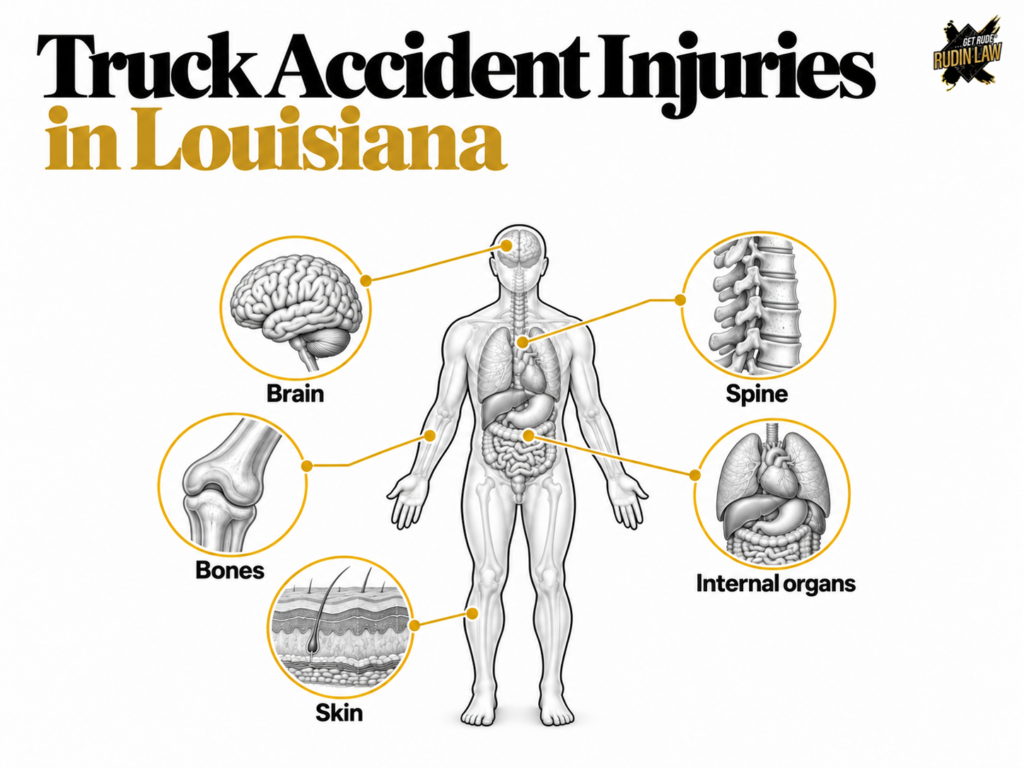
Big-rig crashes can cause serious injuries and can be fatal. The injuries can include:
- Traumatic brain injury
- Spinal cord injury
- Crush and internal injuries
- Amputation
How badly you’re hurt affects what your claim is worth, and so do these other factors:
- Medical specials and future care. Medical specials are the bills you’ve already got. Future care is the treatment still ahead.
- Earning-capacity loss. This is the drop in what you can earn over your working life.
- The insurance layers. The coverage behind the truck decides how much money is there to pay your claim.
- How fault gets split. For crashes on or after January 1, 2026, Louisiana uses a 51 percent bar. If you’re found 51 percent or more at fault, you get nothing. If it’s less, your recovery gets cut by your share (La. C.C. art. 2323). For crashes before that, it’s pure comparative fault. No cutoff. The insurer can say you share the blame. A judge or jury decides.
- Venue. This is the parish and court where we file your case.
- How strong the preserved evidence is. What we preserve early can help prove how the crash happened.
If a truck crash leads to a death, families have one year from the death or two years from the injury, whichever is longer, to bring a wrongful death claim (La. C.C. art. 2315.2(B)). Medical malpractice deaths have different deadlines.
If you want to know more about common truck accident injuries, we have an overview. If the truck was carrying hazardous materials, higher coverage tiers come into play. For severe injuries, it helps to know what counts as a catastrophic injury from a big-rig crash.